


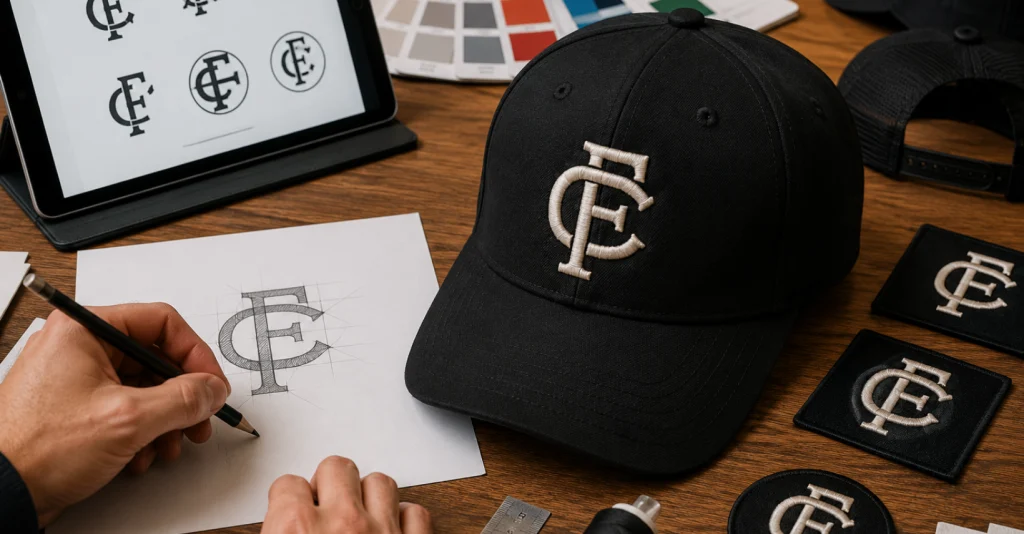
A great logo can make a cap instantly recognisable.
Whether you are launching a fashion label, promoting a business, building a sports team identity, organising an event, or creating merchandise for your community, putting the right logo on a cap can turn simple headwear into a powerful piece of branding.
But creating a custom cap logo is slightly different from designing a logo for a website, business card, or social media profile. A cap has limited space, curved surfaces, different materials and specific decoration requirements. A design that looks perfect on a computer screen may not always translate well into embroidery or printing.
At Custom Caps Factory, we help businesses, brands, teams, organisations and creators turn their ideas into personalised headwear. From embroidered logos and patches to printed artwork, woven labels and custom colours, the right combination of design and cap style can create merchandise people genuinely want to wear.
In this guide, we will explain how to create a custom cap logo from the initial idea through to choosing the right cap, decoration technique and final placement.
What Is a Custom Cap Logo?
A custom cap logo is a brand mark, graphic, symbol, name, slogan or piece of artwork specifically prepared for application to a cap or hat.
Your logo might be:
- A company logo
- A fashion brand symbol
- A sports team crest
- A club emblem
- A personal monogram
- A business name
- A short slogan
- A graphic illustration
- A combination of text and imagery
The important thing is that the design needs to work on the physical surface of a cap.
Unlike a website, where your logo can be displayed at almost any size, a cap usually offers a relatively small branding area. Fine details, tiny text and complicated artwork may therefore need to be simplified or adapted.
A successful cap logo balances recognition, readability, style and production practicality.
Why Your Cap Logo Matters
A custom cap is more than an accessory.
When someone wears a branded cap, your logo travels with them. It can appear at sporting events, festivals, offices, gyms, concerts, university campuses, retail spaces and everyday social settings.
This makes custom caps useful for both branding and merchandise.
For businesses, a branded cap can help create a consistent appearance among employees or promotional teams. For fashion brands, a cap can become a standalone product within a wider collection. For sports clubs, matching headwear can strengthen team identity.
The logo is usually the visual focal point.
That means your design needs to communicate your identity quickly.
A strong custom cap logo should be:
Recognisable
People should be able to identify your brand without needing to study the design.
Simple
Simple logos generally reproduce more effectively on smaller surfaces.
Appropriate for your audience
A streetwear label may want a bold, contemporary graphic, while a professional business might prefer a clean embroidered wordmark.
Consistent with your brand
Your cap should feel like part of your existing identity rather than a completely separate product.
Suitable for production
The design needs to work with the chosen decoration method, cap fabric and available branding area.
Step 1: Start With Your Existing Brand Identity
If you already have a logo, you do not necessarily need to create a completely new one.
Instead, begin by looking at the logo you currently use across your website, packaging, clothing, social media and marketing materials.
Ask yourself:
- What are my main brand colours?
- Does my logo contain text?
- Does it include small details?
- Is it horizontal, vertical or circular?
- What part of the logo is most recognisable?
- Would the full logo fit comfortably on a cap?
- Does the logo need to be simplified?
For example, a company may have a detailed logo containing an icon, company name, slogan and additional graphic elements.
Trying to reproduce every element in a small embroidered area may make the finished design look crowded.
In that situation, you might use the main symbol on the front of the cap and reserve the company name for another location.
This approach can create a cleaner and more premium appearance.
Step 2: Decide What You Want Your Logo to Communicate
Before choosing colours and embroidery, think about the message behind your cap.
What should someone think when they see it?
For example:
Premium fashion brand:
Minimal graphics, refined typography and understated colours can create a sophisticated look.
Streetwear label:
Bold lettering, graphic symbols and strong contrast can create a more energetic appearance.
Sports team:
Team colours, mascots, initials and crests can reinforce identity and belonging.
Corporate business:
A clean logo with professional colours can create branded headwear suitable for staff and promotional campaigns.
Outdoor brand:
Simple icons, natural colour combinations and durable-looking materials can complement the brand’s environment.
Your cap logo should support the purpose of the product.
Step 3: Choose the Right Logo Style for a Cap
There are many ways to approach a custom cap logo.
Wordmark Logos
A wordmark uses the brand name as the primary design.
This can work particularly well for companies with short names or distinctive typography.
For example, a simple brand name embroidered across the front of a baseball cap can create a clean and timeless appearance.
The key is selecting lettering that remains readable at the finished size.
Monogram Logos
Monograms use initials or a small combination of letters.
They are particularly useful when the full company name is too long for the available branding space.
A well-designed monogram can also create a premium fashion aesthetic.
Symbol Logos
A symbol can be used without the full company name when the graphic is already strongly associated with the brand.
This approach is useful for sports clubs, fashion labels and established businesses.
Combination Logos
A combination logo includes both text and an icon.
These can be highly versatile because the elements can sometimes be used together or separately depending on the cap and placement.
Badge or Crest Logos
Circular, shield-shaped and badge-style designs are popular for sports teams, clubs, communities and heritage-inspired brands.
These designs can work particularly well as embroidered patches.
Step 4: Consider the Size of Your Logo
One of the biggest mistakes people make when creating a cap logo is designing without considering the final physical size.
A design that looks detailed at large size may lose clarity when reduced.
Before production, consider:
- Overall logo width
- Overall logo height
- Letter size
- Line thickness
- Small graphic elements
- Spacing between elements
- Distance from seams and edges
The ideal size depends on the cap style, design and decoration technique.
A front logo on a structured baseball cap may have different requirements from a small side logo on a 5-panel cap.
Instead of choosing a size purely because it looks good on screen, consider how the finished cap will actually be worn.
Step 5: Choose the Right Cap Style
Your logo is only one part of the finished product.
The cap itself has a major influence on how the design looks.
At Custom Caps Factory, you can choose from a range of styles including:
Baseball Caps
Baseball caps are one of the most versatile options for branded headwear.
They work for businesses, sports teams, fashion brands, events and everyday merchandise.
A front-panel logo provides a traditional and highly visible branding position.
Snapback Caps
Snapbacks caps offer an adjustable closure and a structured, contemporary appearance.
They are especially popular for streetwear, youth-focused brands, events and statement merchandise.
A bold logo can work particularly well on the structured front.
Trucker Caps
Trucker caps combine a structured front with a breathable mesh back.
They can be suitable for outdoor brands, lifestyle businesses, events and casual merchandise.
Their relaxed appearance makes them a popular choice for bold logos and graphic designs.
5-Panel Caps
Five-panel caps provide a clean front profile that can work beautifully with contemporary branding.
They are often chosen by fashion labels, creative brands and businesses looking for a modern appearance.
6-Panel Caps
The six-panel construction offers a classic cap shape that works across corporate, sportswear, lifestyle and fashion applications.
Fitted Caps
Fitted caps provide a streamlined appearance without an adjustable rear closure.
They can be an excellent option for sports merchandise and premium collections.
Beanie Caps
For colder seasons, a logo can also be transferred onto personalised beanies.
Embroidery is particularly useful for creating a recognisable branded winter accessory.
Step 6: Choose Your Cap Colour
Colour is one of the easiest ways to make your logo stand out.
Your cap can either complement your logo or provide contrast.
For example:
Black cap + white embroidery
Creates a strong, high-contrast appearance.
Navy cap + white logo
Provides a classic and versatile look.
White cap + dark logo
Creates a clean and contemporary appearance.
Neutral cap + tonal logo
Creates a more subtle premium aesthetic.
You can also coordinate your cap colour with your existing brand colours.
If your brand uses a specific colour across your website and packaging, incorporating the same colour into your cap can strengthen visual consistency.
Step 7: Decide Between Embroidery, Printing and Patches
Once your logo and cap style are selected, you need to decide how the artwork will be applied.
Different techniques create different visual effects.
Embroidery
Embroidery is one of the most popular choices for custom cap logos.
The design is stitched directly onto the cap using thread.
It creates a textured finish that can feel premium and durable.
Embroidery is particularly suitable for:
- Company logos
- Initials
- Names
- Simple graphics
- Sports logos
- Fashion branding
- Short text
For clean designs with strong shapes, embroidery can create an excellent finished result.
3D Puff Embroidery
If you want your logo to have additional dimension, 3D puff embroidery can be considered.
This technique creates a raised effect, making selected parts of the design stand above the cap surface.
It can work especially well for bold lettering and simple logos.
However, highly detailed designs may not always be suitable for puff embroidery. The artwork needs to be prepared with the technique in mind.
Printed Designs
Printing can be useful when your artwork contains fine details, illustrations, gradients or multiple colours that may not translate effectively into traditional embroidery.
It can be a good option for creative artwork where preserving visual detail is important.
Custom Patches
Patches provide another flexible way to display a logo.
Depending on the design, you may consider embroidered or woven patch styles.
Patches can be especially effective for:
- Club badges
- Sports logos
- Fashion graphics
- Outdoor brands
- Event merchandise
- Decorative branding
Woven Labels
Woven labels provide a subtle branding option.
They can be used on suitable parts of a cap to add small brand details without creating a large front logo.
Heat Transfer
Heat transfer can also be suitable for compatible cap materials and designs where a smooth, detailed finish is preferred.
The best option depends on your artwork, material, colours and desired appearance.
Step 8: Prepare Your Logo Artwork Correctly
Good artwork preparation can make the production process much easier.
If possible, provide your logo in a high-quality digital format.
Vector artwork is particularly useful because it can be scaled without losing the underlying design quality.
Common professional formats may include:
- AI
- EPS
- SVG
- High-resolution PNG
If you only have a low-resolution image, don’t worry.
A professional cap supplier can review the artwork and determine whether it needs adjustment before production.
The important thing is not to simply enlarge a poor-quality image and assume it will automatically become production-ready.
Step 9: Simplify Your Logo When Necessary
Sometimes the best cap logo is not exactly the same as the original logo.
This does not mean changing your brand identity.
Instead, you may create a cap-friendly version.
For example, a detailed logo could be converted into:
Full brand logo → simplified icon → embroidered cap mark
This allows your business to maintain brand recognition while making the design more suitable for a small physical area.
Remove unnecessary details where appropriate.
Avoid extremely thin lines.
Avoid tiny text when possible.
Create enough space between individual elements.
Remember:
A cap logo needs to look good in the real world, not just on a design screen.
Step 10: Think About Logo Placement
The front is usually the first place people consider, but it is not the only option.
Depending on the cap style, branding may also be possible on:
- Front
- Side
- Back
- Rear closure area
- Other suitable panels
A large front logo provides maximum visibility.
A smaller side logo can create a more subtle fashion-focused appearance.
Some brands combine placements.
For example:
Front: Main brand logo
Side: Small icon
Back: Short slogan or website name
This approach can make a cap feel more like a professionally designed fashion product rather than a simple promotional item.
Step 11: Match the Logo to the Cap Material
The material of your cap can affect the final appearance of the logo.
Common headwear materials include cotton, polyester, nylon and wool-based fabrics.
Cotton can provide a classic, comfortable appearance.
Polyester can be suitable for sportswear and performance-focused applications.
Nylon can work well for lightweight or outdoor-inspired headwear.
Wool and wool-blend materials can create a more premium or traditional aesthetic.
The decoration method should be selected with the material and construction in mind.
For example, a technique that works beautifully on one fabric may not be the best choice for another.
This is why discussing the full project not just the logo is important before production.
Step 12: Create a Mockup Before Production
A digital mockup can help you visualise your idea before the caps are produced.
A good mockup should show:
- Cap style
- Cap colour
- Logo position
- Logo size
- Decoration method
- Overall appearance
Review the mockup carefully.
Ask yourself:
Is the logo too large?
Is it too small?
Does the colour combination work?
Does the design feel balanced?
Does the cap look like something my target audience would actually wear?
This stage is particularly useful for fashion brands and businesses ordering custom merchandise for the first time.
Common Custom Cap Logo Mistakes to Avoid
Creating a cap logo does not have to be complicated, but several common mistakes can affect the final result.
Using Too Much Detail
Small details can disappear when converted into embroidery.
If your design contains lots of tiny elements, ask whether all of them are necessary.
Choosing Very Small Text
Tiny lettering can become difficult to read.
If the wording is not essential, consider removing it or placing it elsewhere.
Ignoring the Cap Shape
A cap is not a flat sheet of paper.
Its curved panels, seams and construction influence the available branding area.
Always consider the actual cap structure.
Using Too Many Colours
A complicated colour palette can make a cap look busy.
A controlled colour scheme often creates a stronger result.
Choosing the Wrong Decoration Method
Not every logo needs embroidery.
Detailed artwork may be better suited to printing or patches, while clean logos can work beautifully with embroidery.
Designing Only for the Screen
Your final product is physical.
Thread has texture. Fabric has movement. Panels curve. Colours can look different under different lighting.
Always evaluate the design as a physical product rather than only as a digital graphic.
Custom Cap Logo Ideas for Different Businesses
A custom logo can be adapted to almost any industry.
Fashion Brands
Fashion labels can use minimalist logos, monograms, bold typography or embroidered symbols.
Neutral caps with tonal embroidery can create a premium aesthetic, while contrasting colours can create a stronger streetwear look.
Restaurants and Cafés
A simple illustrated logo or wordmark can turn caps into wearable staff uniforms or customer merchandise.
Construction and Trades
Bold company names, simple icons and strong contrast can create professional branded workwear.
Sports Teams
Club crests, initials, team names and colours can create coordinated headwear for players, supporters and staff.
Gyms and Fitness Brands
Short slogans, monograms and bold typography can work particularly well on sports-inspired caps.
Events and Festivals
Event logos can be used on caps as merchandise, staff clothing or promotional products.
Corporate Businesses
Clean embroidery can create professional branded caps for employees, campaigns, exhibitions and corporate events.
Clubs and Organisations
Custom caps can help create a shared identity among members while providing useful merchandise.
How to Make Your Custom Cap Look More Premium
A premium-looking cap is not necessarily about adding more decoration.
In many cases, restraint creates a stronger result.
Consider using:
Tonal Branding
Match the logo closely to the cap colour for a subtle, modern appearance.
High-Contrast Branding
Use a contrasting thread colour when visibility is more important.
Minimalist Logos
Remove unnecessary details and focus on the core identity.
Quality Cap Construction
Choose a cap style that matches the positioning of your brand.
Consistent Colours
Use colours that align with your existing brand identity.
Thoughtful Placement
A carefully positioned small logo can sometimes look more sophisticated than an oversized design.
Should You Create a New Logo Just for Your Caps?
Not always.
If your current logo is already recognisable and adaptable, use it.
However, a secondary cap logo can be useful for some brands.
For example, a fashion company may have:
Primary logo: Full company name
Secondary logo: Monogram
Cap mark: Simplified symbol
This gives the brand flexibility across different products.
The key is maintaining a consistent visual relationship between the versions.
How Custom Caps Factory Can Help
Creating a custom cap involves more than sending a logo to a manufacturer.
You need to consider the cap style, material, colour, decoration method, size, placement and overall purpose.
At Custom Caps Factory, we work around your project requirements.
You can share your logo or artwork and discuss the type of headwear you want to create. Depending on the design, we can explore options such as embroidery, printing, patches, heat transfer, woven labels and custom colours.
This allows your logo to become part of a complete headwear product rather than simply being added to a blank cap.
Whether you are developing a fashion collection, ordering branded business merchandise, preparing team headwear or creating promotional products, the goal is to make the finished cap look intentional and wearable.
A Simple Custom Cap Logo Checklist
Before placing your order, review the following checklist.
Logo
- Is the logo recognisable?
- Is the artwork high quality?
- Does the design contain unnecessary details?
- Is small text readable?
Cap
- Have you chosen the right cap style?
- Does the cap colour suit your brand?
- Does the material match your intended use?
Decoration
- Is embroidery suitable?
- Would printing work better?
- Would a patch create the right appearance?
- Do you need a woven label or additional branding?
Placement
- Front?
- Side?
- Back?
- Multiple locations?
Production
- Is the logo size appropriate?
- Has the design been checked for production?
- Have you reviewed the mockup?
- Are the colours and specifications confirmed?
Taking time to review these details can prevent unnecessary changes later.
Final Thoughts: Build a Cap People Want to Wear
A custom cap logo should do more than display a company name.
It should represent your brand, suit the cap, work with the chosen decoration technique and look good enough that people actually want to wear it.
Start with a clear idea of your brand identity. Simplify the artwork where necessary. Choose a cap style that matches your audience. Select the right decoration method and carefully consider the size, colour and placement of your logo.
Most importantly, design the complete product rather than thinking about the logo in isolation.
At Custom Caps Factory, we help turn logos, artwork and concepts into personalised headwear designed around different brands, businesses, teams, events and creative projects.
Whether you already have finished artwork or are still developing your idea, the process starts with one simple step:
Create a logo that represents your brand—and put it on a cap people will be proud to wear.
Ready to Create Your Custom Cap Logo?
Have a logo ready for your next collection? Need branded caps for your business, sports team or event?
Share your design and requirements with Custom Caps Factory and explore the cap styles, colours and customisation options available for your project.
Your logo. Your style. Your cap.